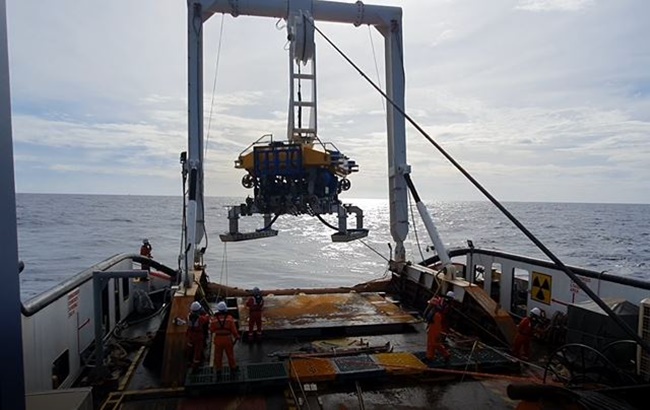
Unmanned underwater construction robots developed with domestic technology have achieved the achievement of entering overseas markets. (Photo. Ministry of Oceans and Fisheries)
The Ministry of Maritime Affairs and Fisheries said that URI-T, an unmanned underwater construction robot for heavy work, was put into the underground construction of a gas pipeline in Vietnam in early August, informing the world of the excellence of unmanned marine construction equipment technology in Korea.
The Ministry of Maritime Affairs and Fisheries and the Korea Ocean Research and Development Institute are currently developing three underwater construction robots such as URI-L for light work, URI-T for heavy work, and URI-R for track-based heavy work through the underwater construction robot development project (2013-2018), and are currently promoting the underwater construction robot demonstration and diffusion project (2019-2022) to improve performance and secure field performance.
The URI-T, which was put into this project, has the ability to inject high-pressure water into the sea floor to dig the ground and lay the pipeline, and has the ability to work up to 2,500m deep. In addition, it has precise control and navigation function, so cables and pipelines can be buried up to 3m deep, and work at speeds up to 2km per hour, which is twice as fast as overseas competitors' products. In addition, it is equipped with a device capable of maintaining and repairing submarine cables such as cables, pipeline search devices, and cutters, which is highly efficient in terms of equipment operation.
As part of the SAO VANG and DAI NGUYET GAS Fields development project promoted by the Vietnam state-owned company Petro Vietnam Technical Services Corporation, the Vietnam gas pipeline is located on the seabed 350 km southeast of Ho Chi Minh City in southern Vietnam. It is a construction that is buried at a depth of about 14.5 km (29 km in total) each. URI-T participated in the project thanks to active technical cooperation between KOC, which operates URI-T, and APMC, a offshore plant company that won the construction.
URI-T is currently working on excavation of pipelines and installation of gas pipes under the technical support of the Korea Robot Convergence Research Institute. It will be put into the underground water pipe construction of Geoje city after finishing the construction of Vietnam at the end of September. In the future, URI-T and other unmanned underwater construction robots will continue to be put into domestic and overseas submarine cables and structures.
“We expect that this case of the domestic unmanned underwater construction robot entering the overseas market will not only reduce the cost of leasing overseas equipment, but also serve as an opportunity to inform the world of the excellence of domestic underwater construction robot technology,” said Yoo Eun-won, director of the Ministry of Maritime Development and Fisheries. “We will continue to upgrade the technology of underwater construction robots and will continue to provide active support to secure competitiveness in the current $1.9 billion (as of 19) overseas underwater construction market.” ...