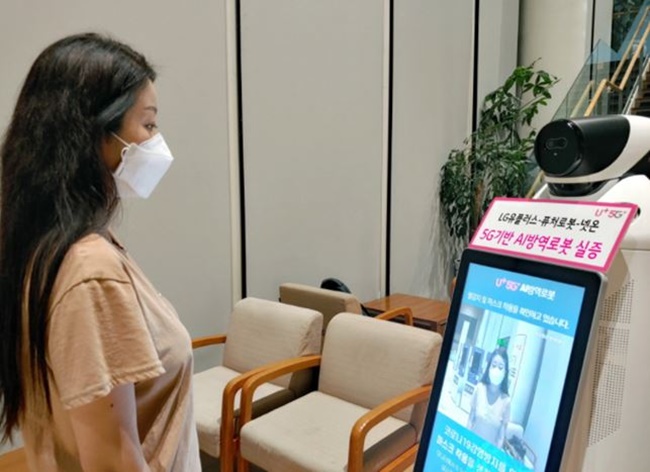
LG U + is launching a 5G-based AI anti-virus robot / Photo. LG U +
Like Tuxk and Ipsk, 5G anti-virus robots are available to prevent high-risk infections of new coronavirus infections (Corona 19), and to greatly increase the efficiency of anti-virus management.
LG Uplus announced on September 3 (Thursday) that it has signed a business agreement (MOU) with Future Robot, a developer of autonomous robots, and Neton, a face recognition solution company, on the 5G-based AI anti-virus robot (hereinafter referred to as 5G anti-virus robot).
The 5G anti-virus robot, which is introduced by the three companies, is a robot that moves inside the building by autonomous driving and checks whether to wear a mask and body temperature through face recognition and temperature measurement. For example, if a robot finds someone who does not wear a mask on the move, it provides a real-time alarm to the central control room with a guide voice about wearing the mask.
In particular, 5G anti-virus robots were the first domestic robot to apply multi-face recognition technology. Multiface recognition technology is an advanced deep learning based AI technology that enables to recognize multiple faces as well as the face of a moving person. Up to 10 faces are recognized at the same time, and the results can be analyzed within 0.3 seconds. It also determines when the mask is not properly worn like a 'tuxk' or 'ipsk' as an accurate recognition result.
The 5G anti-virus robot also has a thermal imaging camera capable of measuring ultra-precision temperature. The temperature is automatically measured at an average ±0.3 degrees to an error range of up to ±0.5 degrees, so that high-risk people over 37.5 can be safely identified in non-face-to-face.
In addition, the control center can check the monitoring image of the 5G anti-virus robot remotely and control it in real time by 5G-based high-speed and ultra-low delay communication. In addition, the control system can inquire the history of the 5G anti-virus robot, such as the occurrence of unmasked masks, and is useful in responding to emergencies.
Major officials attended the agreement ceremony, which was held at the Yongsan office of LG U + and Future Robot headquarters (Seongnam city, Gyeonggi province), Neton headquarters (Gwangju city), including LG U + Seo Jae-yong, managing director of the fusion business, Future Robot Seo Sang-cheol, and Neton Myung Hong-cheol.
According to the agreement, the three companies will carry out demonstrations for the technical verification of 5G anti-virus robots. In particular, from this month, they plan to expand the scope of application such as public institutions, starting with demonstration with H + Yangji Hospital.
“The 5G anti-virus robot can greatly improve the efficiency of the work by allowing indoor corona 19 anti-virus management without any additional personnel at major facilities with many visitors,” said Seo Jae-yong, managing director of the LG Uplus’s fusion business. “It will be a great help to create a safe environment from Corona 19 along with an intelligent visitor management system based on image analysis.”
“We are expected to provide mid- to long-term business opportunities to collect the expertise of the three companies and provide them to various customers through this cooperation,” said Seo Sang-chul, CEO of Future Robot. “In particular, we plan to focus our company’s capabilities on building a stable and effective service platform through our proven self-driving-based AI robots.”
“As the importance of non-face-to-face protection due to corona 19 increases, the artificial intelligence facial recognition market is growing rapidly, but most of them are using overseas technology,” said Myeong Hong-chul, CEO of NetOn. “This agreement is a good example of the technology of domestic start-ups and face recognition technology will be applied more diversely to real life.”
Meanwhile, LG U + established an intelligent visitor management system based on image analysis at H + Yangji Hospital in Seoul in August. This system is a technology that determines whether visitors, patients, and workers can enter the hospital door through an intelligent image analysis solution equipped with AI.The access allowable whether or not is rapidly determined through the body temperature sensing of the man passing through the gate, the mask wearing whether or not confirmation, the face recognition etc.